


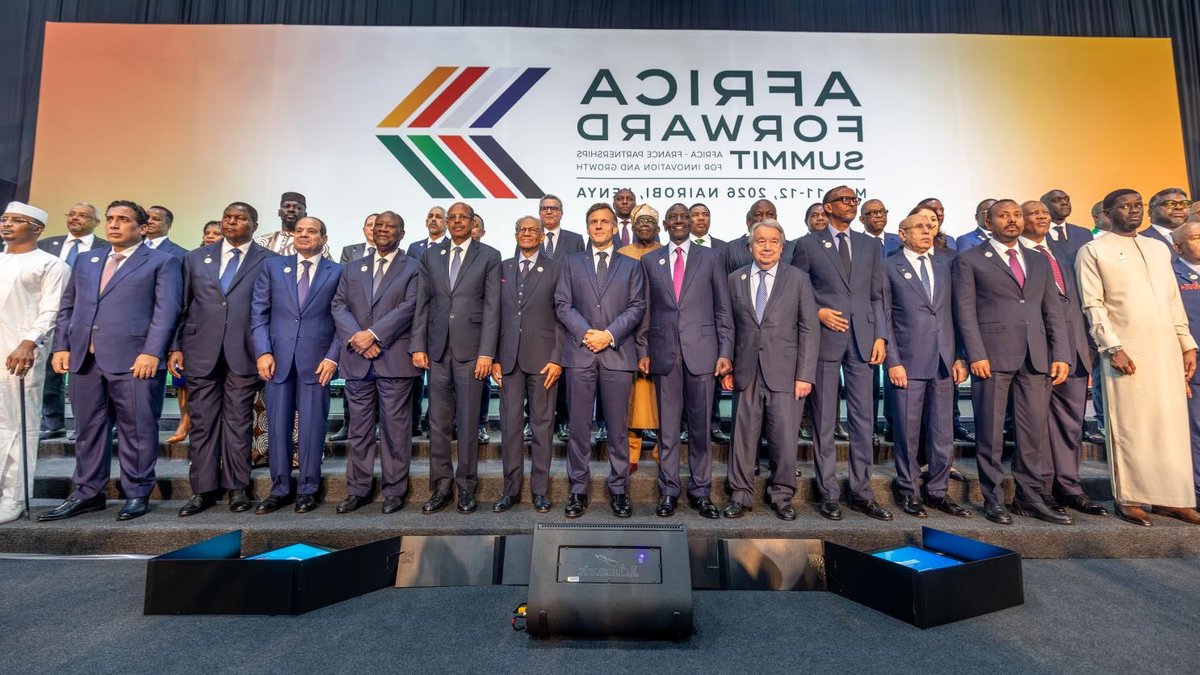
Nairobi hosted a major effort this week to transform sovereign infrastructure into a global asset class. Leaders at the G7 Africa Forward Heads of State Summit advanced a framework aimed at drawing trillions in institutional capital to Africa’s energy, minerals, and digital sectors.
The event, co-led by Kenyan President William Ruto and French President Emmanuel Macron, brought together over 30 African heads of state, sovereign wealth funds, multilateral institutions, and global financial leaders. Their objective was to repackage national infrastructure as a standardized product suitable for institutional investors managing more than $300 trillion.
From projects to portfolios
The current approach treats infrastructure as isolated development projects. Officials noted this method does not align with how institutional investors operate, as they rely on benchmarks, ratings, and predictable cash flows rather than individual deals.
“Development has long been structured as episodic projects while institutional portfolios focus on asset classes,” said Dr. Hubert Danso, chairman and CEO of Africa Investor Group. “The key change is shifting from making investment developmental to making development investable.”
The new Sovereign Infrastructure (SI) framework seeks to close this gap. It standardizes long-term contracts, credit ratings, and repeatable structures across five sectors: energy, critical minerals, logistics, compute, and trade corridors. The design follows the model used by institutional investors in real estate or private equity—through pooled, scalable vehicles instead of custom projects.
Kristian Flyvholm, CEO of the Institute of Sovereign Investors, described the advancement of “benchmark frameworks for sovereign infrastructure allocation.” His organization, which advises sovereign wealth funds, collaborated on the framework with the Sustainable Markets Initiative and Africa Investor.
Related: The Definitive Guide to Strategic Business Growth in the Digital Age
Investors at the event highlighted the absence of standardized structures as the main obstacle to scaling capital, not a lack of available funds. Danso explained that capital scales only where admissibility, benchmark integration, and execution certainty align.
A $7 trillion opportunity
Africa’s infrastructure requirements for its climate and industrial transition range between $3 trillion and $7 trillion. This represents one of the largest emerging opportunities for global investors, covering energy, critical minerals, logistics, and compute.
The Summit also introduced the Institutional Investor–Public Partnership (IIPP) framework. It establishes rules for risk-sharing, offtake agreements, and dispute resolution. The model aims to lower perceived sovereign risk by clarifying responsibilities for delays, cost overruns, or policy changes—issues that have historically discouraged private investment.
Challenges remain. Most African nations lack the legal and regulatory systems needed to support large-scale, long-term infrastructure contracts. Some investors doubt governments can maintain consistent policies over the 20- to 30-year lifespans typical of energy or transport projects.
The initiative reflects a shift in global finance. As artificial intelligence and industrial supply chains demand more energy and raw materials, sovereign infrastructure is gaining recognition as a strategic asset within global portfolios. If successful, the model may change how nations fund ports, power grids, and other essential systems, turning them from financial burdens into portfolio staples.
The immediate focus is on demonstrating the concept’s viability. The next step will determine whether the first standardized deals meet the returns and stability institutional investors require.


